One school, two developers. Warsaw is testing a new model of city-building.
-
26.03.2026
Warsaw is preparing to implement one of the more interesting educational investments of recent years. A new public primary school is planned on Radzymińska Street in the Targówek district, designed by the WWAA studio. This is quite a unique project on a citywide scale and one of the first cases in which two developers—Skanska and Spectra/Pinao—are co-creating a single school as part of a larger urban development. The facility is to be built at the center of a new residential district being developed on the site of the former Targówek Fabryczny industrial area.
The area, where the Warsaw Vegetable Oil Industry Works operated for decades, is gradually undergoing transformation. From a post-industrial hinterland, it is changing into a new part of Warsaw with housing, greenery, and public services. The school designed by WWAA is being developed as part of an urban concept selected in a competition announced by the city in 2015, created by Dawos + BBGK. Based on this concept, new housing developments are being designed by Spectra/Pinao (according to BBGK’s masterplan) and by Skanska, whose buildings are designed by JEMS Architekci. This is one of the first places in Warsaw where, on such a large scale, the principles of the so-called Warsaw Social District are to be implemented—a model assuming that schools, kindergartens, and shared spaces are built simultaneously with residential buildings, rather than many years later.
“This is a special investment for us, because for the first time we are implementing a project based on the Lex Developer act. We treat it not only as a tool for building housing, but also as an opportunity to co-create a well-designed, complete living environment. That is why the school is such an important element of our proposal—it is a real contribution to local infrastructure and something that will serve both future residents and the current community of this part of the district. Together with the second investor, we want to create a coherent piece of development that functions on a daily basis, not just provides new apartments. The school is key in this project, as it gives the area self-sufficiency and makes it a fully-fledged, vibrant part of the district,” says Aleksandra Sokołowska, project manager at Skanska Residential Development.
One school – two buildings
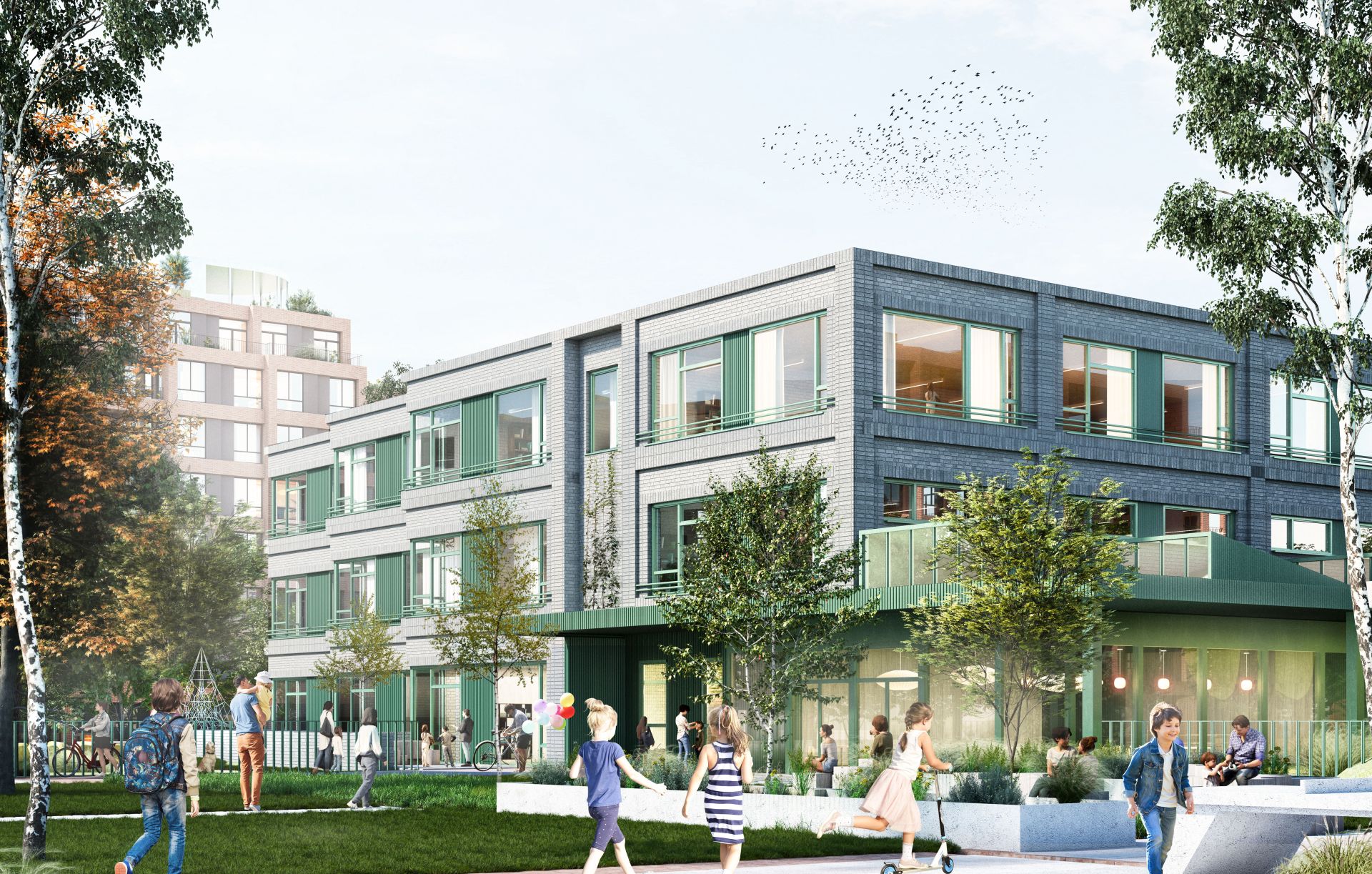
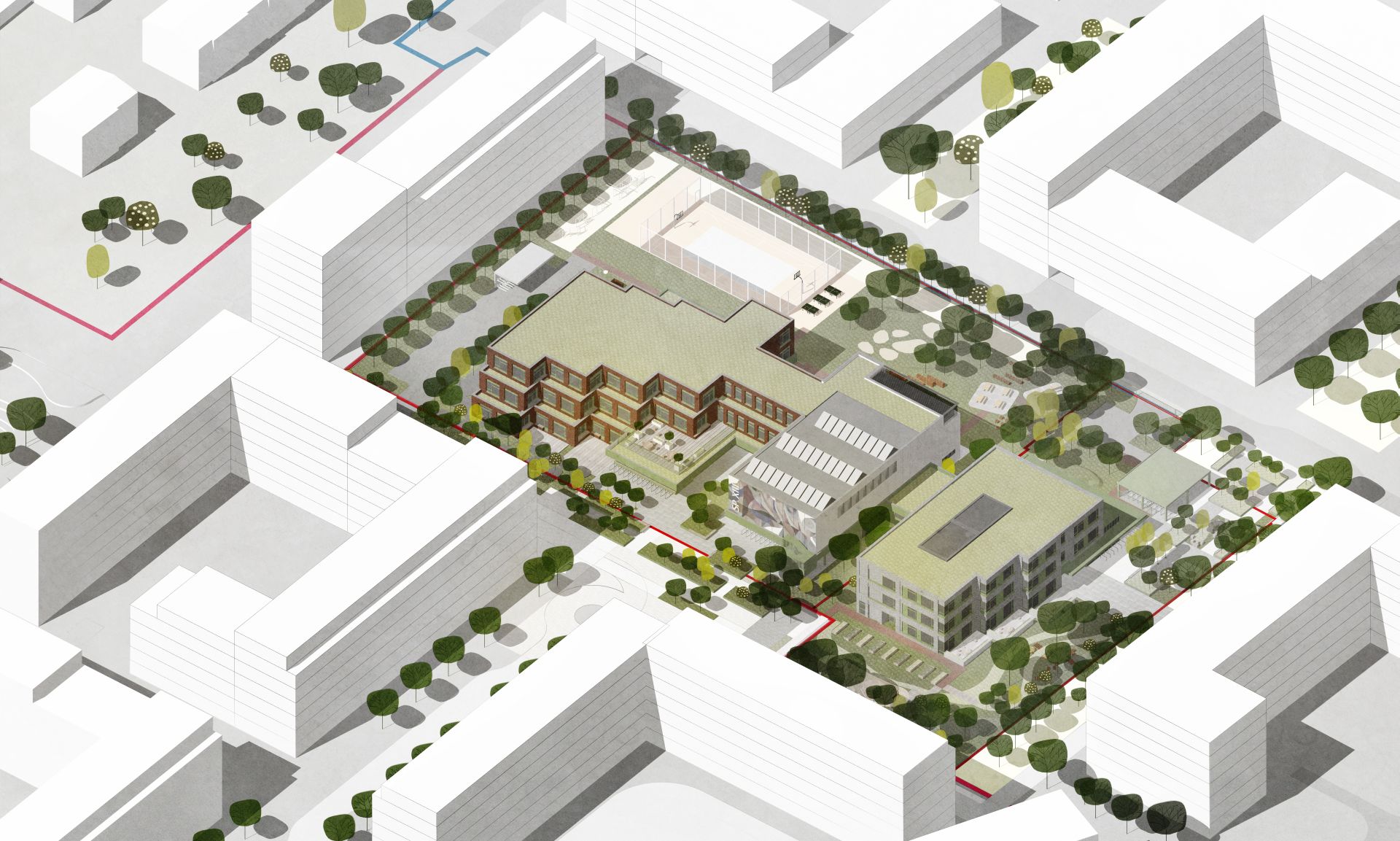
The planned school will consist of two parts developed by different investors, which will ultimately form a cohesive building functioning as a single institution. For the architects from WWAA, this meant designing a structure that maintains functional and spatial integrity despite the division of the investment. “A major challenge was to design two buildings carried out under separate procedures, potentially built at different times, which will ultimately merge into one efficiently functioning organism—so that future users are not even aware of the former boundary dividing the site,” emphasizes architect Natalia Paszkowska from WWAA. The keystone of this composition will be a sports hall located at the center of the layout, serving as the architectural focal point with a wall decorated with a mosaic.
A school for 400 students
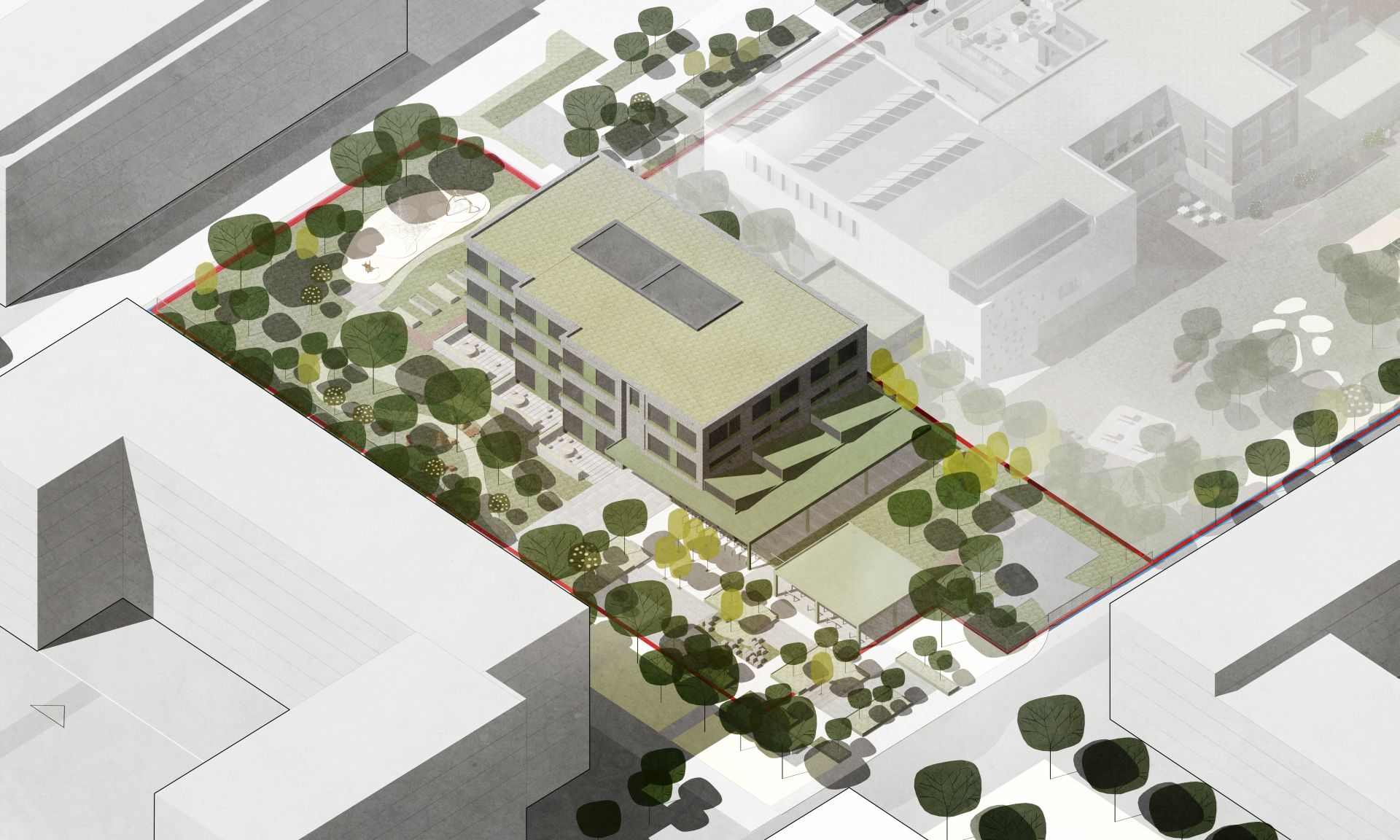
The project envisions a school for approximately 400 students. The section developed by Spectra/Pinao will include 15 classrooms with a total usable area of about 4,700 m², while the part planned by Skanska will include 9 classrooms and around 2,300 m². The classrooms are arranged to ensure dual-aspect daylight and natural ventilation, resulting in a distinctive cascading building form. The school buildings will have between two and three storeys. One of the key functional elements will be a separate block for the youngest students (grades 1–3), equipped with its own entrance, cloakrooms, dining area, and dedicated outdoor play zones.
Inspired by history
The architecture of the school deliberately references the history of the site. The investment area is a former industrial complex, where an impressive brick chimney of the old boiler house still survives. The material and scale of the buildings are intended to correspond both to the industrial past of this part of the city and to the new residential development emerging around the school.
One of the key elements of the concept is also public space. The architects designed two entrance squares. The first, more representative one, will be located along the axis of Aleja Szkolna—the main urban spine of the Spectra/Pinao development—and will lead to the school’s main hall, sports facilities, and library. The second, more intimate, will be intended for younger children. Both will include greenery, seating, bicycle racks, and recreational elements, so that they become natural meeting spaces for the local community. WWAA emphasizes that the square in front of the school can be more than just an entrance zone—it can act as a kind of urban foyer for a public building. The school will also be connected to a network of green and recreational areas. A green corridor with playgrounds, a sports field, and a calisthenics zone will lead to the entrance area for younger students, ending on the other side of Bieżuńska Street at a planned public kindergarten.
A flexible school of the future
The project is being developed in line with the “Well-Designed School” standards, which emphasize multifunctionality and flexibility of space. WWAA architects plan that, after school hours, parts of the infrastructure—such as the sports hall, library, dining area, and sports grounds—will also be available to local residents. The school is therefore intended to function not only as an educational building, but also as a local activity center. For now, the investment is still at an early stage of preparation. Public consultations will continue until March 25, 2026, and the project has not yet received approval from the Warsaw City Council. However, if it is implemented as planned, the school in Targówek may become one of the first examples in Warsaw where public infrastructure is developed simultaneously with a new district, rather than only after residents have already become accustomed to its absence. And perhaps it is precisely such projects that mark the beginning of a city that grows a little more wisely than before