
The primary school on Konstruktorska Street
Project: 2020–2025
Developer: Echo Investment
Location: Konstruktorska, Służewiec, Warsaw
Team: Natalia Paszkowska, Marcin Mostafa, Krzysztof Mazanek, Ryszard Rychlicki, Izabela Bartosik, Stefan Kielman, Konrad Niziołek, Marta Kastelik, Ireneusz Kossakowski, Krzysztof Jakubów, Alina Markovska, Karolina Matysiak, Katarina Kędrak
Graphics: Maciej Chodziński
Photographs: Sebastian Rzepka
Aerial photographs from the archives of DFM POLSKA, by Sylwester Ciszek
The aim of the project was to create a building that serves as a community space, addressing the question of how a school should function within an urban setting. The concept behind the school on Konstruktorska Street is not only to support contemporary education in an urban context, but also to demonstrate an approach to architecture as an educational tool that shapes attitudes, fosters sensitivity to public space, and encourages care for the environment.
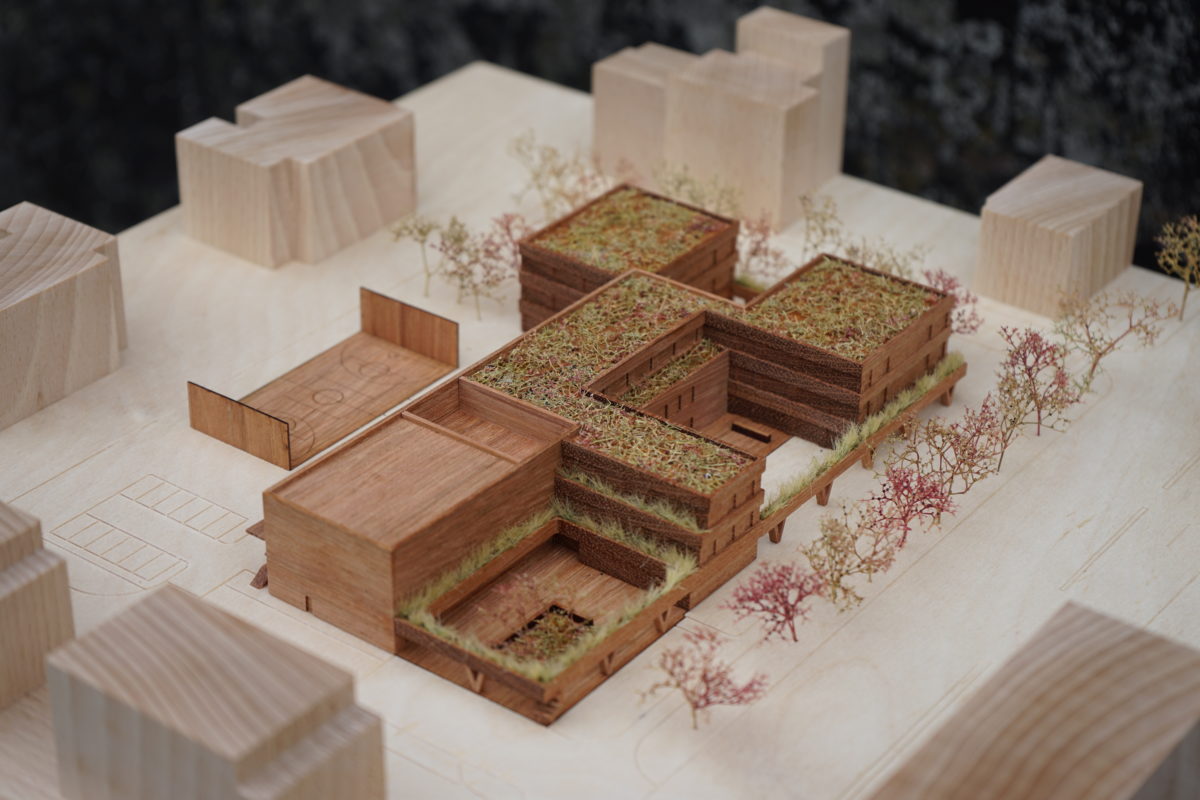
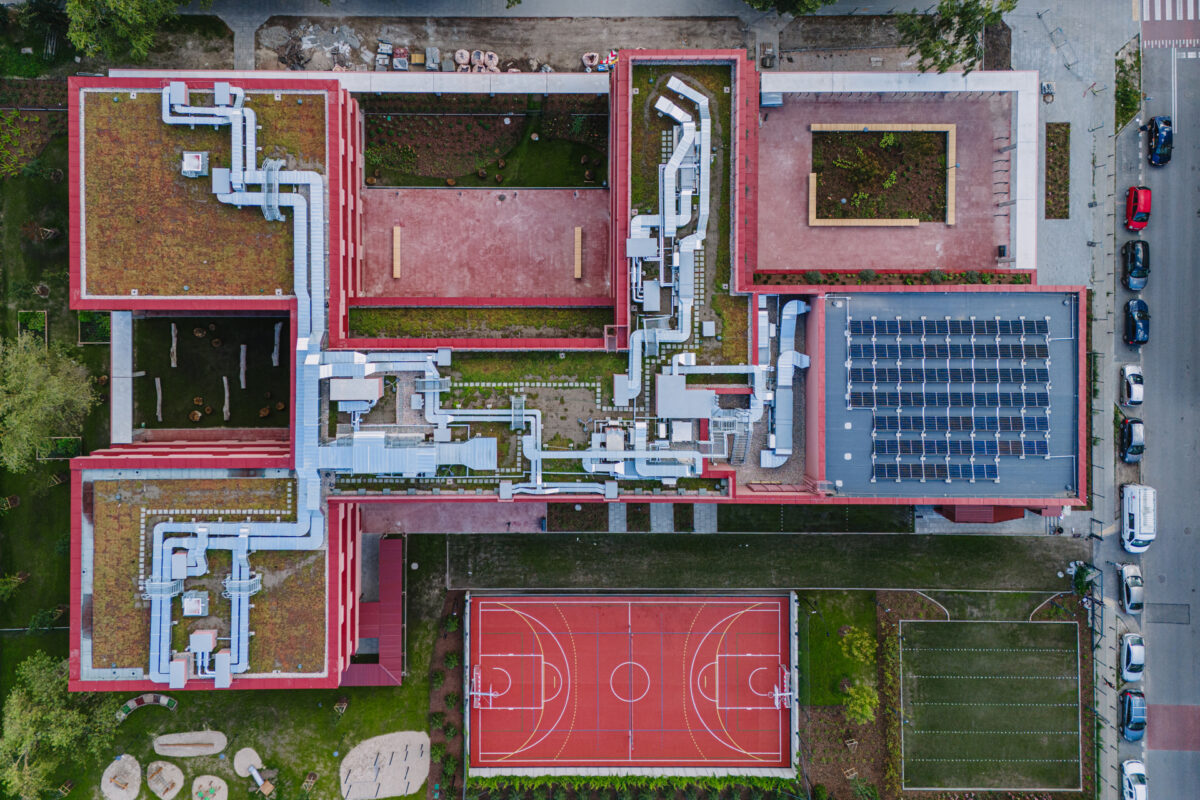
The project’s premise was a school that not only fulfils educational functions but also becomes an integral part of the urban fabric, responding to the needs of both pupils and local residents. This translates into the layout of the building, which is based on a sequence of closely interlinked external and internal spaces.
The core of the building consists of three main functional blocks:
– the public block – with spaces accessible to the local community, namely the library and the gymnasium,
– the semi-public / recreational block – with a dining room opening onto the central atrium and the southern outdoor patio,
– the “private” / educational block – with two clusters of classrooms and a green classroom; the north-eastern cluster on the ground floor also includes space for a nursery.
With a user-friendly layout of the individual zones in mind, the starting point for shaping the building was the appropriate location of the public entrance plaza and the corner arrangement of the classrooms, each with access to two façades. This arrangement ensures optimal natural lighting and promotes natural ventilation.
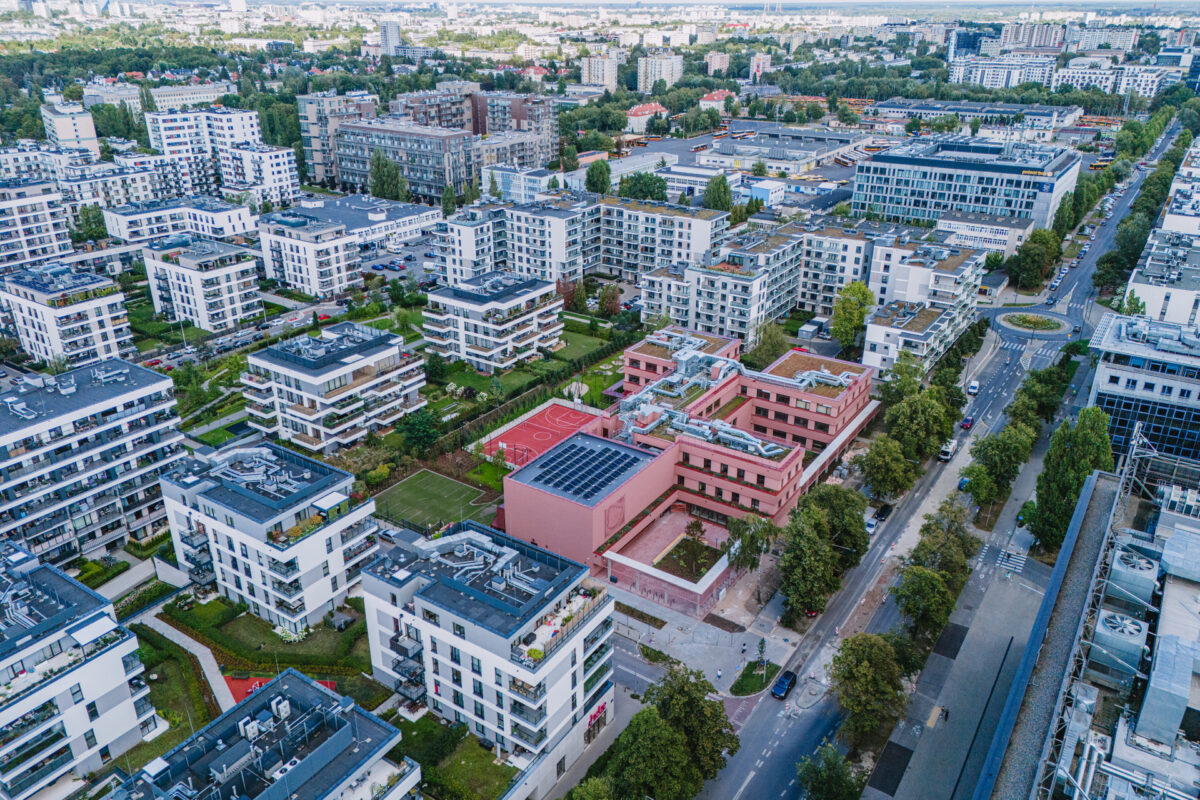
The axial layout of the building, with distinct clusters of individual functions combined with external courtyards, creates a coherent structure in which the architecture has the potential to act as a counterbalance to the surrounding area, which is being intensively developed with new residential buildings.
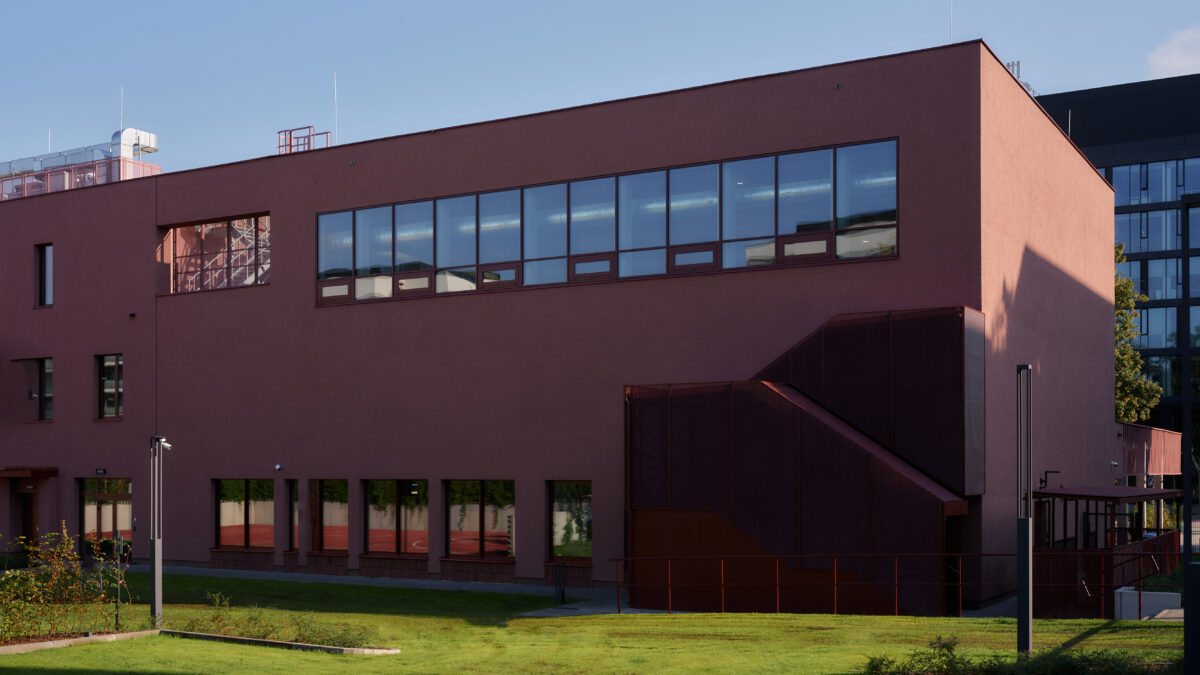
The school’s open entrance plaza brings a sense of spatial relief to the surrounding dense development, while canopies featuring metalwork elements define the plaza’s boundaries. This gives it a clear identity as part of the building, while keeping it open and accessible to all. The canopies also enclose the external courtyards, emphasising their intimate character.
The design incorporates greenery on the façades, with a diverse mix of low shrubs, grasses, and flowering perennials, aimed at increasing biodiversity by creating habitats and food sources for various species of birds and insects, which also serves an educational purpose.
It was precisely the belief that the building itself can inspire and play a role in educating the youngest pupils that prompted the search for solutions designed to reveal to users those parts of the building that are usually hidden. Visible technical installations and structural elements within the interior allow pupils to better understand how the building’s infrastructure works and the importance of individual systems.
By avoiding the use of plaster and concealing structural elements and technical installations, it was possible to reduce the consumption of raw materials and the energy required for their production and transport. This approach, which prioritises the rational use of resources, has enabled the minimisation of the building’s carbon footprint.


Mając na uwadze czytelne dla użytkownika rozmieszczenie poszczególnych stref punktem
wyjścia do kształtowania bryły stała się odpowiednia lokalizacja publicznego placu
wejściowego oraz narożny układ sal lekcyjnych z dostępem do dwóch elewacji. Takie
rozmieszczenie sal zapewnia optymalne doświetlenie pomieszczeń oraz sprzyja naturalnej
wentylacji. Osiowy układ bryły z wyodrębnionymi klastrami poszczególnych funkcji w
połączeniu z zewnętrznymi dziedzińcami tworzy spójną strukturę, w której architektura ma
szansę stać się przeciwwagą dla otoczenia intensywnie uzupełnianego nową zabudową
mieszkaniową. Otwarty plac wejściowy szkoły wprowadza oddech w otaczającej gęstej
zabudowie a daszki z elementami metaloplastyki wyznaczają ramy placu. Nadaje mu to
czytelną tożsamość jako części obiektu, a jednocześnie pozostawia go otwartym i
ogólnodostępnym. Daszki domykają również zewnętrzne dziedzińce, podkreślając ich
kameralny charakter.


W projekcie przewidziano zieleń na elewacjach, wielogatunkowe nasadzenia niskich krzewów, traw i bylin kwitnących, których celem jest zwiększenie bioróżnorodności poprzez tworzenie siedlisk oraz źródeł pożywienia dla różnych gatunków ptaków i owadów, co dodatkowo pełni funkcję edukacyjną. To właśnie założenie, że sam budynek może inspirować i mieć swój udział w edukowaniu najmłodszych popchnęło nas do szukania rozwiązań mających na celu pokazanie użytkownikowi elementów budynku, które są zwykle ukryte. Widoczne instalacje techniczne czy elementy konstrukcyjne we wnętrzu, pozwalają uczniom lepiej zrozumieć działanie infrastruktury budynku i znaczenie poszczególnych systemów. Rezygnacja z tynku, zabudów elementów konstrukcyjnych i instalacji technicznych pozwoliło nam ograniczyć zużycie surowców i energii potrzebnej do ich produkcji oraz transportu. Takie rozwiązanie, które stawia na racjonalne gospodarowanie zasobami pozwoliło nam zminimalizować ślad węglowy.